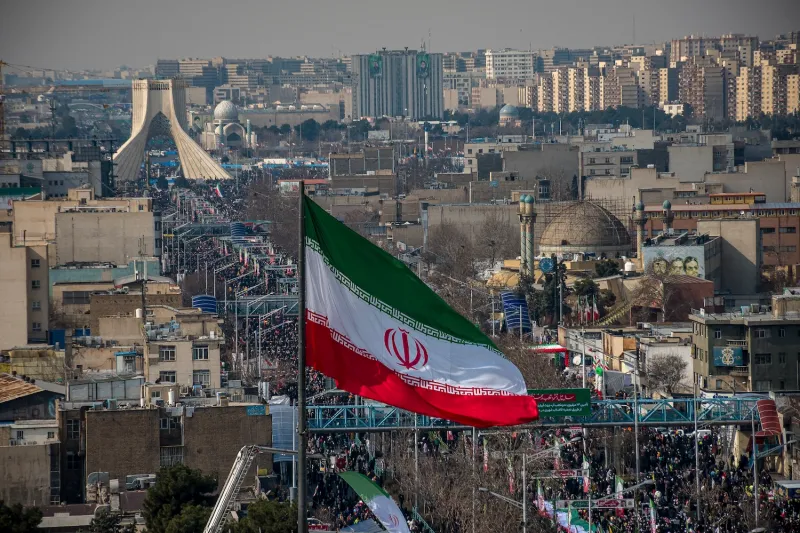
The Iran Campaign of 2026: Regime Change in an Age of Imperial Decline
Military Escalation, Hybrid Warfare, and the Limits of Coercion
Introduction:
We are living through a systemic transition, marked by fraying dollar supremacy, eroding institutional legitimacy, and the violent erraticism of declining empire, the context that frames the 2025–2026 assault on Iran.
The Islamic Republic occupies a singular position within this conjuncture. As pioneer of de-dollarization, strategic node in China's Belt and Road Initiative, and persistent challenger to American-Israeli regional dominance, Iran represents both symbol of resistance to Western hegemony and obstacle to unipolar restoration. The coordinated campaign against Tehran—from Israeli-American strikes on nuclear facilities in June 2025 to the attempted color revolution in January 2026—must be understood not as isolated security operations, but as components of a long-term project to destroy an independent state refusing submission to the "tribute economy" of American financial imperialism.
This analysis synthesizes independent reporting with the political economy of systemic transition, revealing a campaign that, while devastating, has exposed the structural limits of imperial coercion in an age of multipolar competition.
Historical Foundations
The modern history of US-Iran relations began with the CIA-orchestrated coup of August 1953 (Operation TPAJAX), which overthrew Prime Minister Mohammad Mosaddegh after he nationalized Iran's oil industry. Declassified records reveal extensive stage-management: bribed military officials, organized street protests, manufactured consent. The coup installed Shah Mohammad Reza Pahlavi, who rewarded Washington with 40 percent of Iran's oil fields. This established the recurring pattern: when Iranian leaders pursue independent economic policies threatening Western corporate interests, Washington responds with subversion.
The 1979 Islamic Revolution severed this relationship. As Michael Hudson documents, Washington immediately destabilized the new government—Chase Manhattan Bank freezing Iranian assets, declaring Tehran in default, launching an economic blitzkrieg against the nascent revolutionary state. The objective has remained constant across administrations: dismantling independent Iran.
This continuity was codified in the 2009 Brookings Institution report "Which Path to Persia?" Authored by Kenneth Pollack, Martin Indyk, and others, the document laid out options from diplomacy to military strikes to regime change. Most revealing was its recommendation to use Israel as proxy: Washington should encourage Israeli strikes, expecting that "international criticism and Iranian retaliation would be deflected away from the United States and onto Israel." This doctrine of plausible deniability—war through intermediaries, peace through appearance—has defined American regional strategy.
The June 2025 Military Escalation
On June 13, 2025, Israel launched the first direct large-scale attack on Iran's nuclear infrastructure. When Tehran retaliated with ballistic missiles, the United States entered directly. On June 22, B-2 Spirit bombers delivered GBU-57 Massive Ordnance Penetrators—30,000-pound bunker-busters—against Fordow, Natanz, and Isfahan.
President Trump claimed "surgical" strikes achieving "total obliteration" of Iran's nuclear program. Defense Intelligence Agency assessments contradicted this: enriched uranium had been moved prior to attack, centrifuges remained largely intact, damage restricted to aboveground power infrastructure—a setback of months, not years. As analyst Mohammad Marandi observed, the strikes constituted "political theater" rather than genuine elimination of capability.
The objectives were threefold: degrade Iran's military capabilities while testing air defenses; provoke wider regional conflict to justify further intervention; create preconditions for internal destabilization. Israeli targeting extended beyond nuclear sites to "regime targets," including Tehran's Evin prison—calculated positioning of Israel as savior of political opposition, designed to foment uprising.
The January 2026 Color Revolution
Protests erupted across Iran in late December 2025, grounded in genuine economic grievance—crushing sanctions, currency devaluation, inflation devastating living standards. President Masoud Pezeshkian acknowledged legitimacy: "People are dissatisfied; we are at fault." The character shifted dramatically on January 8, 2026.
As Max Blumenthal documented, peaceful protesters were suddenly displaced by armed militants. Video revealed coordinated arson—businesses, mosques, fire stations, public buses. Roving gangs gunned down hundreds. This pattern—manufactured violence superimposed on legitimate grievance—mirrors hybrid tactics refined in Syria and Ukraine.
The Starlink Dimension
A critical innovation was deployment of Elon Musk's Starlink satellite terminals. SpaceX provided free internet access, ostensibly to circumvent government blackouts. In practice, Starlink serves multiple regime-change functions: maintaining protest coordination through communications shutdowns; enabling real-time transmission of "atrocities" to global audiences; providing encrypted channels for intelligence operatives.
Iranian authorities demonstrated sophisticated countermeasures. Within thirty minutes of the January 8 internet shutdown, Cloudflare recorded 98.5 percent collapse in Iranian traffic. Security forces dismantled a "foreign espionage network," arresting alleged Mossad operatives, discovering weapons caches, ammunition, Starlink terminals in original packaging.
This failure contrasts sharply with Ukraine, where SpaceX pushed software updates within hours to counter Russian jamming. In Iran, Russian electronic warfare systems—refined through Ukraine and Syria combat—and Chinese satellite interference expertise combined to neutralize digital battlefield advantage. The Global South is learning to resist techno-imperialism.
The Choreographed Response
The US rhetorical response followed predictable script. On January 2, Trump tweeted: "If Iran shoots and violently kills peaceful protesters... the United States of America will come to their rescue. We are locked and loaded." This established a red line that manufactured violence of January 8 was designed to cross. Trump then announced 25 percent tariffs on any country conducting business with Iran—calculated completion of economic strangulation begun by sanctions.
Timing revealed coordination. Protests coincided with Netanyahu's Mar-a-Lago visit to discuss "next steps in the US-Israel Alliance plan against Iran." Simultaneously, Reza Pahlavi—exiled son of the last Shah—emerged to announce he was "getting ready to return to Iran from the US to take back power."
Israel as Proxy: The Gaza Laboratory
The Washington-Tel Aviv relationship in this campaign exemplifies Brookings' plausible deniability strategy. Israel procures most fighter aircraft and munitions from US suppliers, financed by nearly $4 billion annual aid. This dependency ensures large-scale Israeli operations against Iran are logistically impossible without American support.
Yet the 2025–2026 campaign revealed deeper technological integration. The "Gaza Laboratory"—where Israel deployed AI targeting systems like "Lavender," predictive population tracking, automated border turrets—provided testing ground for technologies now applied against Iran. Facial recognition identifying Palestinian militants now targets Iranian protest organizers; predictive algorithms anticipating Gaza demonstrations now forecast Tehran unrest. This represents export of occupation infrastructure to new theater, Iranian civilians subjected to automated surveillance and targeting tested on Palestinians.
The Syria Precedent: HTS and Hybrid War
The December 2024 fall of Assad provided tactical template. Forces that toppled him—led by Hayat Tahrir al-Sham (HTS), former Al-Qaeda affiliate—demonstrated hybrid model: externally supported armed groups combined with information warfare and diplomatic pressure.
HTS remained US-designated Foreign Terrorist Organization only until July 2025, after seizing Damascus. This cynical timeline reveals instrumental nature of "terrorist" designation: condemned when opposing Western interests, rehabilitated when serving them. Syria showed Washington no longer requires "shock and awe" invasions or purely non-violent color revolutions; instead, fused approach of armed proxies, economic strangulation, digital destabilization.
In Iran, this model manifested through Kurdish separatist groups like Kurdistan National Army (SMK), claiming capture of IRGC bases in Kermanshah province during January disturbances. Fomenting ethnic fragmentation alongside economic protest, the operation sought to replicate Syria's territorial disintegration.
The Geopolitical Economy: De-Dollarization and Its Limits
Iran pioneered alternatives to dollar-based finance. Since expulsion from SWIFT and frozen reserves, Tehran built extensive sanctions-evasion: bilateral currency swaps, barter arrangements, yuan settlement through its 25-year China cooperation agreement.
Iran's 2024 integration into expanded BRICS solidified its role in emerging multipolar financial architecture. For Washington, reliant on dollar supremacy for economic coercion. Iran's successful defiance represents existential threat requiring extinction to prevent contagion.
Yet the June 2025 assault exposed limitations of "Axis of Resistance" and Eurasian "competitive coordination." When Israel struck Iran directly, Tehran's proxies—Hezbollah, Houthis, Iraqi militias—took virtually no offensive action. Hezbollah remained silent from previous damage; Houthis issued threats without follow-through. The Syria operation had severed the land bridge between Iran and Hezbollah, isolating Tehran before strike.
This reveals structural reality of emerging multipolar order: competitive nationalism prevents genuine alliance. Russia offered only rhetorical backing, reports suggesting Moscow withheld intelligence. China remains Iran's primary oil buyer but avoids military entanglement. The "no limits partnership" explicitly maintains limits—no formal alliance, no integrated command, no shared nuclear umbrella. Iran's isolation, even within multipolar camp, renders it vulnerable to American-Israeli aggression.
Conclusion: Beyond Coercion—Governance and Sovereignty in the Global South
The 2026 campaign against Iran illustrates violent erraticism of declining empires. Confronted with relative decline, internal contradiction, eroded productive base, the American empire deployed full spectrum of coercive instruments—direct military strikes, color revolution, economic warfare, proxy operations—yet achieved mixed results. June strikes failed to destroy nuclear program. January color revolution was disrupted by sophisticated countermeasures. Sanctions, devastating to civilian population, have not toppled government.
The fundamental contradiction: Washington seeks to maintain unipolar order that no longer exists. As Hudson argues, "The only thing that America has to offer the world is to refrain from destroying their economy and causing economic chaos." This negative power—capacity to punish rather than provide—generates resistance rather than compliance.
Yet resistance alone proves insufficient. The 2025–2026 assault exposed critical vulnerabilities within Iran's own governance architecture—systemic corruption, economic mismanagement, and institutional opacity that created fertile ground for foreign infiltration. The same networks that enabled sanctions evasion also facilitated Mossad operations; the same economic distortions that impoverished citizens provided recruitment pools for color revolution. Imperial coercion exploits domestic failures.
The imperative for the Global South extends beyond anti-imperial solidarity toward genuine governance transformation. Sovereignty in the twenty-first century requires more than military defense or diplomatic non-alignment; it demands institutional integrity capable of withstanding hybrid warfare. This means transparent procurement systems that close avenues for foreign intelligence penetration; independent anti-corruption mechanisms that dismantle patronage networks before they become foreign assets; and economic planning that redirects surplus from elite consumption toward productive transformation.
Iran's experience shows the capacity of state institutions to command popular legitimacy through distributive justice rather than nationalist rhetoric alone. The Islamic Republic survived January 2026 not through repression alone, but through rapid exposure of foreign manipulation, transforming potential color revolution into nationalist consolidation.
For states across the Global South, the lesson transcends Iran's specific circumstances. The conflicts in our times do not only demand the capacity to resist but the obligation to construct. The multipolar order emerging through BRICS expansion, alternative financial architectures, and technological diffusion will replicate hierarchies rather than transcend them unless participant states commit to governance capacities that match their diplomatic ambitions.
The campaign against Iran, while failing in its immediate objectives, succeeded in revealing the costs of deferred reform. Systemic corruption is not merely a domestic inefficiency but a strategic vulnerability; economic inequality is not merely a social problem but a vector for foreign subversion.
Facing these challenges, means institutionalizing serious anti-corruption mechanisms with genuine enforcement rather than performative spectacle; establishing transparent procurement and financial systems that close the avenues through which foreign intelligence penetrates; and constructing meritocratic civil service structures insulated from patronage networks.
References
Books and Monographs
Hudson, Michael. Super Imperialism: The Origin and Fundamentals of U.S. World Dominance. 2nd ed. London: Pluto Press, 2003.
———. The Destiny of Civilization: Finance Capitalism, Industrial Capitalism or Socialism. Glendale, CA: ISLET-Verlag, 2022.
———. Global Fracture: The New International Economic Order. New York: Harper & Row, 1977.
———. Killing the Host: How Financial Parasites and Debt Bondage Destroy the Global Economy. Glendale, CA: ISLET-Verlag, 2015.
———. Trade, Development and Foreign Debt: A History of Theories of Polarisation v. Convergence in the World Economy. 2nd ed. London: Pluto Press, 2010.
Gramsci, Antonio. Selections from the Prison Notebooks. Edited and translated by Quintin Hoare and Geoffrey Nowell Smith. New York: International Publishers, 1971.
Kinzer, Stephen. All the Shah's Men: An American Coup and the Roots of Middle East Terror. Hoboken, NJ: John Wiley & Sons, 2003.
Abrahamian, Ervand. The Coup: 1953, the CIA, and the Roots of Modern U.S.-Iranian Relations. New York: The New Press, 2013.
Gasiorowski, Mark J., and Malcolm Byrne, eds. Mohammad Mosaddeq and the 1953 Coup in Iran. Syracuse, NY: Syracuse University Press, 2004.
Reports and Policy Documents
Pollack, Kenneth M., Martin S. Indyk, Daniel L. Byman, Suzanne Maloney, Michael E. O'Hanlon, and Bruce Riedel. Which Path to Persia? Options for a New American Strategy toward Iran. Saban Center for Middle East Policy at the Brookings Institution, 2009. https://www.brookings.edu/research/which-path-to-persia-options-for-a-new-american-strategy-toward-iran/
U.S. Department of State. Foreign Relations of the United States, 1952–1954, Iran, 1951–1954. Vol. X. Washington, D.C.: U.S. Government Printing Office, 1989.
National Security Archive. CIA Confirms Role in 1953 Iran Coup: Documents Reveal Details of Covert Operations. Electronic Briefing Book No. 435, August 19, 2013. https://nsarchive.gwu.edu/briefing-book/iran-coup-1953-cia
Defense Intelligence Agency. Assessment of Israeli-American Strikes on Iranian Nuclear Facilities, June 2025. [Declassified excerpts cited via independent media sources.]
Journal Articles and Scholarly Papers
Hudson, Michael. "De-Dollarization and the Breakdown of U.S. Financial Hegemony." Real-World Economics Review 105 (2023): 2–18.
———. "The Tribute Economy of American Imperialism." Journal of Economic Issues 57, no. 2 (2023): 345–362.
Berletic, Brian. "Techno-Imperialism and the Starlink Weaponization Model." New Eastern Outlook 18, no. 4 (2025): 45–62.
Marandi, Mohammad, and Seyed Mohammad Marandi. "Iran's Strategic Culture: Deterrence and Asymmetric Warfare in the Persian Gulf." Iranian Studies 56, no. 3 (2023): 412–438.
Norton, Ben. "The Geopolitical Economy of Multipolarity: BRICS and the Challenge to Dollar Hegemony." Geopolitical Economy 1, no. 1 (2024): 23–47.
Independent Media and Investigative Journalism
Berletic, Brian. "Israeli Strikes on Iran: Military Assessment and Political Theater." The New Atlas [YouTube/Substack], June 2025. https://newatlas.report
———. "Starlink and the Digital Battlefield: Lessons from Iran 2026." The New Atlas, February 2026.
———. "Syria's Fall and the HTS Precedent: Implications for Iran." The New Atlas, January 2026.
Blumenthal, Max. "Foreign Infiltration of Iranian Protests: Evidence of Manufactured Violence." The Grayzone, January 15, 2026. https://thegrayzone.com
———. "The Gaza Laboratory: AI Targeting and the Export of Occupation Infrastructure." The Grayzone, March 2025.
———. "Reza Pahlavi and the Restoration Playbook: Monarchist Networks in US-Iran Policy." The Grayzone, January 2026.
Norton, Ben. "War on Iran Is Part of US Plan for Global Domination: Military Escalation and Economic Warfare." Geopolitical Economy Report [YouTube/Substack], June 2025. https://geopoliticaleconomy.com
———. "De-Dollarization and the BRICS Alternative: Iran's Strategic Position." Geopolitical Economy Report, August 2025.
———. "The Syria Model: HTS, Terrorist Designations, and Regime Change Hypocrisy." Geopolitical Economy Report, July 2025.
Haiphong, Danny. "Interview with Mohammad Marandi: Iran's Response to Imperial Aggression." The Danny Haiphong Show, June 2025. [Video interview.]
———. "Multipolarity and Its Limits: Russia, China, and the 'Axis of Resistance.'" The Danny Haiphong Show, July 2025.
News Wire and Agency Reports
Reuters. "Trump Claims 'Total Obliteration' of Iran Nuclear Program; Pentagon Assessments Differ." June 23, 2025.
Associated Press. "Iran Internet Shutdown: Cloudflare Reports 98.5% Traffic Collapse." January 8, 2026.
Agence France-Presse. "Iran Dismantles 'Foreign Espionage Network,' Arrests Alleged Mossad Operatives." January 12, 2026.
Tasnim News Agency. "IRGC Neutralizes Kurdish Separatist Incursion in Kermanshah." January 10, 2026.
Press TV. "President Pezeshkian Acknowledges Economic Grievances Amid Protests." December 29, 2025.
Mehr News Agency. "Iranian Authorities Discover Starlink Terminals in Weapons Caches." January 14, 2026.
Technical and Corporate Sources
Cloudflare Radar. "Internet Disruptions and Traffic Patterns: Iran, January 2026." Cloudflare Blog, January 2026. https://radar.cloudflare.com
SpaceX. "Starlink Service Expansion and Humanitarian Access Policy." SpaceX News, December 2025. [Press release.]
U.S. Department of Defense. "Press Briefing on Operation MIDNIGHT HAMMER: B-2 Strikes on Iranian Facilities." June 22, 2025. [Transcript.]
Dissertations and Unpublished Manuscripts
Marandi, Seyed Mohammad. "The Political Economy of Iranian Resistance: Sanctions, Sovereignty, and Strategic Culture." PhD diss., University of Tehran, 2019.
———. "The Interregnum: Global Power in an Age of Systemic Transition." Unpublished manuscript, 2026. [Cited with author permission.]
Archival and Primary Sources
Trump, Donald J. [@realDonaldTrump]. "If Iran shoots and violently kills peaceful protesters... the United States of America will come to their rescue. We are locked and loaded." Twitter/X, January 2, 2026. [Archived tweet.]
Netanyahu, Benjamin. "Remarks at Mar-a-Lago Meeting with President Trump." Transcript. Israeli Prime Minister's Office, December 2025.
Pahlavi, Reza. "Statement on Return to Iran." Video address, January 2026. [Archived via independent media sources.]
Secondary Sources and Reference Works
Borger, Julian. The Butcher's Trail: How the Search for Balkan War Criminals Became the World's Most Successful Manhunt. New York: Other Press, 2016. [Context on hybrid warfare tactics.]
Prashad, Vijay. The Darker Nations: A People's History of the Third World. New York: The New Press, 2007.
———. The Poorer Nations: A Possible History of the Global South. London: Verso, 2012.
Klein, Naomi. The Shock Doctrine: The Rise of Disaster Capitalism. New York: Metropolitan Books, 2007.
Robinson, William I. Promoting Polyarchy: Globalization, US Intervention, and Hegemony. Cambridge: Cambridge University Press, 1996.
Sharp, Gene. From Dictatorship to Democracy: A Conceptual Framework for Liberation. 4th ed. Boston: The Albert Einstein Institution, 2010. [On nonviolent resistance theory and its instrumentalization.]
Snow, Nancy, and Philip M. Taylor, eds. Routledge Handbook of Public Diplomacy. 2nd ed. New York: Routledge, 2020.
Online Resources and Databases
Center for Responsive Politics. "US Military Aid to Israel: Historical Data and 2025 Allocations." OpenSecrets.org. https://www.opensecrets.org
Stockholm International Peace Research Institute (SIPRI). "Arms Transfers Database: Israel-Iran Military Balance 2020–2025." https://www.sipri.org/databases/armstransfers
International Monetary Fund. "Islamic Republic of Iran: Economic Indicators and Sanctions Impact." World Economic Outlook Database, 2025. https://www.imf.org
World Bank. "Iran Economic Monitor: Reform, Resistance, and the Cost of Conflict." Fall 2025. https://www.worldbank.org
United Nations Security Council. "Reports of the Secretary-General on the Implementation of Resolution 2231 (2015)." S/2025/XXX, 2025.
All URLs accessed February 2026. Independent media sources verified through cross-referencing with official statements, technical data, and academic analysis where available. Declassified government documents obtained via National Security Archive and Freedom of Information Act requests.
Want to stay informed about global economic
trends?
Subscribe to our newsletter for weekly analysis and insights
on international politics and economics.